Suffolk County Dog Registration Information
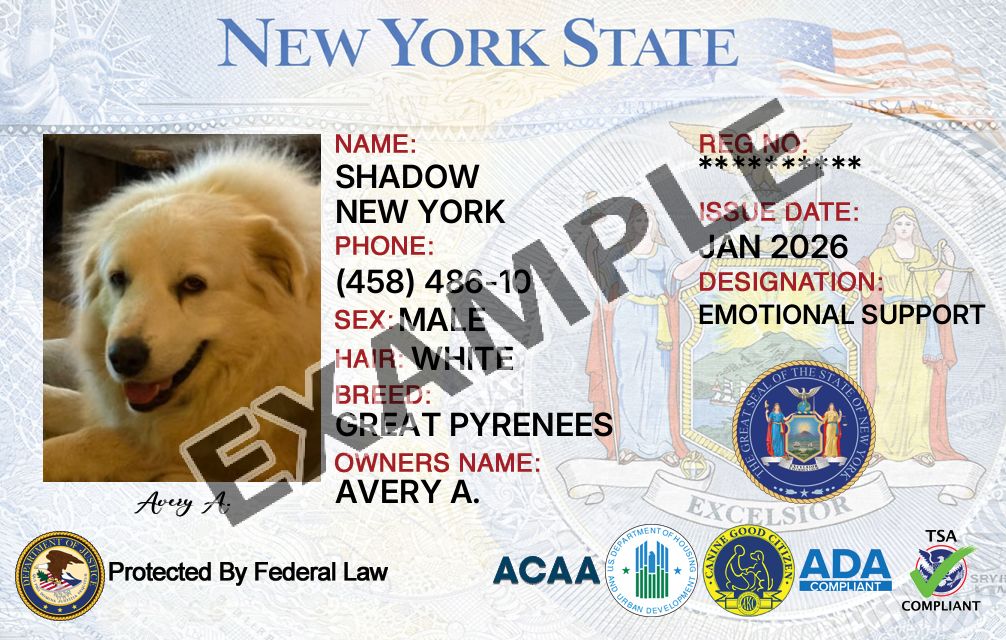
Service Dogs and Emotional Support Animals in Suffolk, New York
If you’re asking, “where do I register my dog in Suffolk County, New York for my service dog or emotional support dog”, the key thing to know is this: in most cases, what people call “registering” a dog is actually getting a dog license in Suffolk County, New York through the town (or village) where you live—not through a countywide “service dog registry” or paid online listing.
This page explains where to register a dog in Suffolk County, New York, how local licensing works, what rabies paperwork you’ll need, and the important legal differences between a dog license, a service dog, and an emotional support animal (ESA).
- A dog license is a local government record tied to rabies compliance and identification.
- Service dog legal status comes from disability laws and training/behavior standards—not from buying an ID card or “registration.”
- Emotional support animals may be recognized in certain housing contexts, but an ESA is not the same as a service dog for public access.
Where to Register or License Your Dog in Suffolk County, New York
In Suffolk County, dog licensing is commonly handled by the Town Clerk (or, in some places, the local animal shelter/animal control office working with the town). Below are several official, local-government examples within Suffolk County. Contact the office that matches your home address.
Town of Brookhaven — Town Clerk (Dog Licensing)
Town of Huntington — Town Clerk (Dog Licensing)
Town of Babylon — Office of the Town Clerk (Dog Licensing)
Town of Smithtown — Town Clerk (Dog Licensing)
Town of Riverhead — Town Clerk
Overview of Dog Licensing in Suffolk County, New York
What “registering” usually means: a local dog license
When most residents ask about “registration,” they mean getting a dog license in Suffolk County, New York. A dog license is a local record that typically connects: (1) the dog’s identity and description, (2) your owner contact information, and (3) proof of rabies vaccination (and sometimes spay/neuter status).
Licensing helps animal control reunite lost dogs with owners, supports rabies control and bite investigations, and confirms compliance with New York State dog licensing requirements.
Rabies vaccination requirements (why it matters for licensing)
In Suffolk County municipalities, a current rabies certificate is commonly required to apply for or renew a dog license. Town dog licensing pages frequently state that proof of rabies vaccination must be provided with the application. If your rabies certificate is expired—or will expire too soon—your clerk may not be able to issue a full-term license until vaccination is updated.
Practical tip: Ask your veterinarian for a clear rabies certificate that includes the vaccination date and expiration date, and keep a copy for renewals.
How Dog Licensing Works Locally in Suffolk County, New York
Why it’s handled locally (town-by-town)
Suffolk County is made up of multiple towns and villages, and dog licensing is typically administered by your local municipality—often through the Town Clerk. That’s why the best answer to “animal control dog license Suffolk County, New York” is usually: start with your town clerk (or the municipal animal shelter/animal control office that supports licensing for your town).
Common steps to get a license
- Find your correct licensing office based on your home address (town/village boundary matters).
- Complete the application (online, by mail, or in-person depending on the town).
- Provide required documents, usually including a current rabies certificate and (if applicable) spay/neuter proof.
- Pay the fee (fees vary by municipality and may differ for altered vs. unaltered dogs).
- Receive the license/tag and keep the tag on your dog’s collar as required locally.
Fees and exemptions (service/working dogs vs. standard licenses)
Fees vary by town. Many municipalities charge different rates for spayed/neutered dogs vs. unaltered dogs. Some towns also describe fee-free or reduced-fee licensing for certain categories such as guide, hearing, police, or war/service dogs. That said, an exemption from a licensing fee is not the same thing as “service dog registration”—you still generally obtain the license through your local clerk, and you still typically provide a rabies certificate.
If you recently moved within Suffolk County
If you moved from one Suffolk County town to another, you may need to re-license under your new municipality’s clerk (or update your record), depending on local policy. Call the new town clerk and ask whether they can transfer your information or require a new application.
Service Dog Laws in Suffolk County, New York
Service dog vs. dog license: two different things
A dog license is a municipal requirement tied to identification and rabies compliance. A service dog is a dog trained to perform tasks for a person with a disability. The service dog’s legal status comes from disability laws and the dog’s training/behavior—not from a purchased certificate or online “registry.”
No “official service dog registry” is required for public access
If someone tells you that you must pay for “registration” to have a service dog, be cautious. In general, public access for service dogs is based on whether the dog is trained to do disability-related work or tasks and is under control. You can still be required to comply with local rules like licensing and rabies vaccination.
What local government may ask for (licensing context)
Your town clerk may have a category on the dog license application for guide/hearing/service/police/working dogs and may require certain supporting paperwork for any fee exemption the town offers. This is about the local license record—it is not a universal or statewide “service dog ID.”
Emotional Support Animal Rules in Suffolk County, New York
ESA vs. service dog (public access is different)
An emotional support animal (ESA) provides comfort by its presence, but it is not trained to perform specific disability-related tasks like a service dog. That difference matters because ESAs generally do not have the same public access rights as service dogs in places like restaurants, stores, or other public businesses.
Licensing still applies to ESAs
Even if your dog is an ESA, you generally still handle “registration” the same way as any other dog: you obtain a dog license in Suffolk County, New York through your local town or village licensing clerk, and you provide required rabies vaccination proof. In other words, if you’re looking for where to register a dog in Suffolk County, New York for an ESA, the starting point is still your local licensing office.
Housing-related documentation (what landlords may request)
Housing providers may have specific processes for accommodation requests. Typically, that involves disability-related documentation and interactive communication with the housing provider—not a paid “ESA registration website.” Requirements can vary depending on the housing type and applicable rules, so it’s best to ask the housing provider what they need and keep your request focused on reasonable accommodation.
Frequently Asked Questions
What You May Need
- rabies vaccination proof
- identification
- proof of residency
- licensing fee
Quick Local Tip
If you’re not sure which municipality you’re in (Brookhaven, Babylon, Huntington, Islip, Smithtown, Riverhead, etc.), use your property tax bill or ask the closest Town Clerk’s office to confirm where your animal control dog license Suffolk County, New York application should be filed.
Register A Dog In Other New York Counties
Select your county below to get started with your dog’s ID card. Requirements and license designs may vary by county, so choose your location to see the correct options and complete your pup’s registration.
- Albany County Dog Registration
- Allegany County Dog Registration
- Bronx County County Dog Registration
- Broome County Dog Registration
- Cattaraugus County Dog Registration
- Cayuga County Dog Registration
- Chautauqua County Dog Registration
- Chemung County Dog Registration
- Chenago County Dog Registration
- Clinton County Dog Registration
- Columbia County Dog Registration
- consolidated borough-county government County Dog Registration
- Cortland County Dog Registration
- Delaware County Dog Registration
- Dutchess County Dog Registration
- Erie County Dog Registration
- Essex County Dog Registration
- Franklin County Dog Registration
- Fulton County Dog Registration
- Genesee County Dog Registration
- Greene County Dog Registration
- Hamilton County Dog Registration
- Herkimer County Dog Registration
- Jefferson County Dog Registration
- Kings County County Dog Registration
- Lewis County Dog Registration
- Livingston County Dog Registration
- Madison County Dog Registration
- Monroe County Dog Registration
- Montgomery County Dog Registration
- Nassau County Dog Registration
- New York County County Dog Registration
- Niagara County Dog Registration
- Oneida County Dog Registration
- Onondaga County Dog Registration
- Ontario County Dog Registration
- Orange County Dog Registration
- Orleans County Dog Registration
- Oswego County Dog Registration
- Otsego County Dog Registration
- Putnam County Dog Registration
- Queens County County Dog Registration
- Rensselaer County Dog Registration
- Richmond County Dog Registration
- Rockland County Dog Registration
- Saratoga County Dog Registration
- Schenectady County Dog Registration
- Schoharie County Dog Registration
- Schuyler County Dog Registration
- Seneca County Dog Registration
- St. Lawrence County Dog Registration
- Steuben County Dog Registration
- Sullivan County Dog Registration
- Tioga County Dog Registration
- Tompkins County Dog Registration
- Ulster County Dog Registration
- Warren County Dog Registration
- Washington County Dog Registration
- Wayne County Dog Registration
- Westchester County Dog Registration
- Wyoming County Dog Registration
- Yates County Dog Registration